
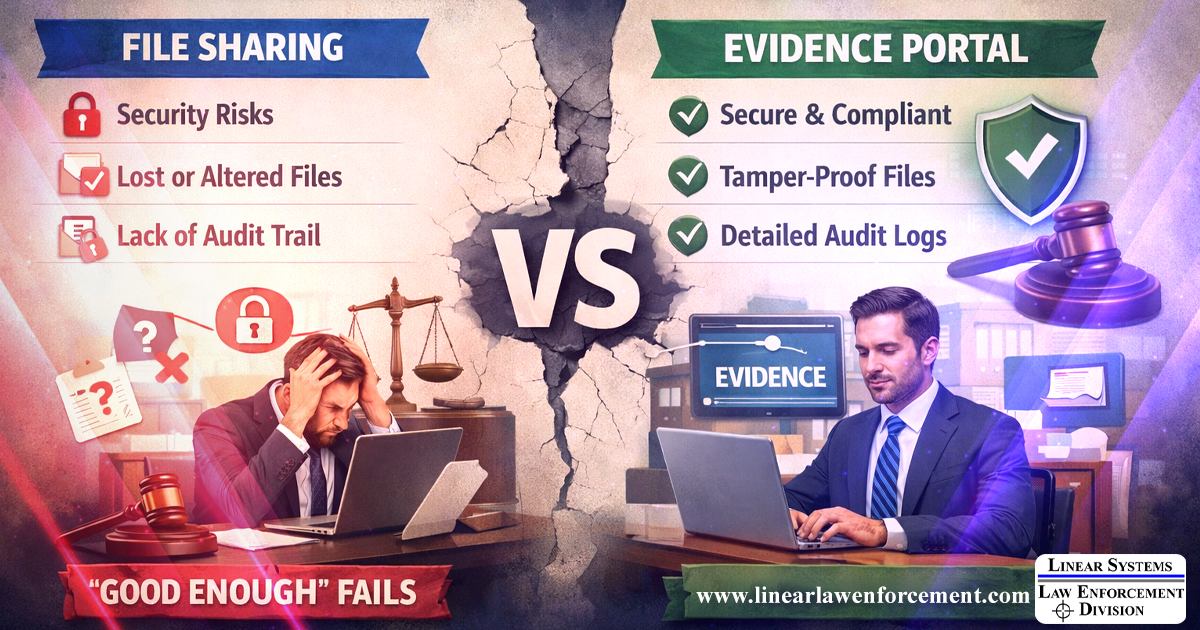
Evidence Portal vs. File Share: Why ‘Good Enough’ Fails in Court
Digital evidence is now central to modern investigations. PDFs, videos, audio files, and phone extraction data are used daily in criminal cases. Yet many agencies still rely on basic file sharing systems to store and transfer this evidence. While file shares may seem convenient, they are not built to meet court standards. When digital evidence is challenged in court, “good enough” systems often fail. A dedicated evidence portal is required for legal defensibility.
Digital Evidence Management vs. Basic File Sharing Systems
File share systems were designed for office documents, not for legal evidence. They allow files to be copied, renamed, moved, and deleted with limited tracking. In most cases, no full history of access or changes is recorded.
In contrast, a digital evidence portal is built specifically for evidence handling. Access is controlled, every action is logged, and the original file is preserved. This difference becomes critical when evidence is reviewed in court.
Chain of Custody Requirements for Digital Evidence in Court
Courts require a verified chain of custody for all digital evidence. It must be shown who accessed the file, when it was accessed, and what actions were taken. File share systems do not provide a complete or tamper-resistant chain of custody.
Dedicated evidence portals maintain a full audit trail from capture through final export. This record supports the legal history of the evidence and reduces the risk of suppression in court.
Data Integrity and Evidence Verification Challenges
With file-sharing tools, files can be altered without detection. There is often no built-in method to confirm that evidence has not been changed. This creates doubt during legal review.
Evidence portals such as the DIMS Portal, use integrity checks such as hash verification. These checks confirm that files remain identical to the original version. When integrity can be verified, the evidence stands on stronger legal ground.
Secure Digital Evidence Access Control for Investigators and Prosecutors
File shares often rely on broad network permissions. Once access is granted, users may download, copy, or forward files without restriction. This increases security risk and weakens audit visibility.
Evidence portals apply role-based access. Investigators, supervisors, and prosecutors are granted only the access needed for their role. Viewing, downloading, and exporting are each controlled and recorded.
Why Law Enforcement Evidence Portals Are Required for Admissibility
Dedicated evidence portals are built for compliance, accountability, and courtroom review. Full audit trails, chain of custody tracking, and data integrity controls are standard features. These functions are required to support evidence admissibility and legal review.
Linear Systems provides dedicated evidence portal solutions designed for these legal and operational demands through its DIMS platform.